Your question library
Keep your questions and explanations together. Revisit a solution when you revise a topic.
Your AI study assistant
Send Raku AI a photo of your question or type it in. Follow the explanation, ask about anything that is unclear, and get a video walkthrough for supported questions.
Join the waitlist for early access.
 Raku AIExample solution
Question 39
View full size (opens in a new tab)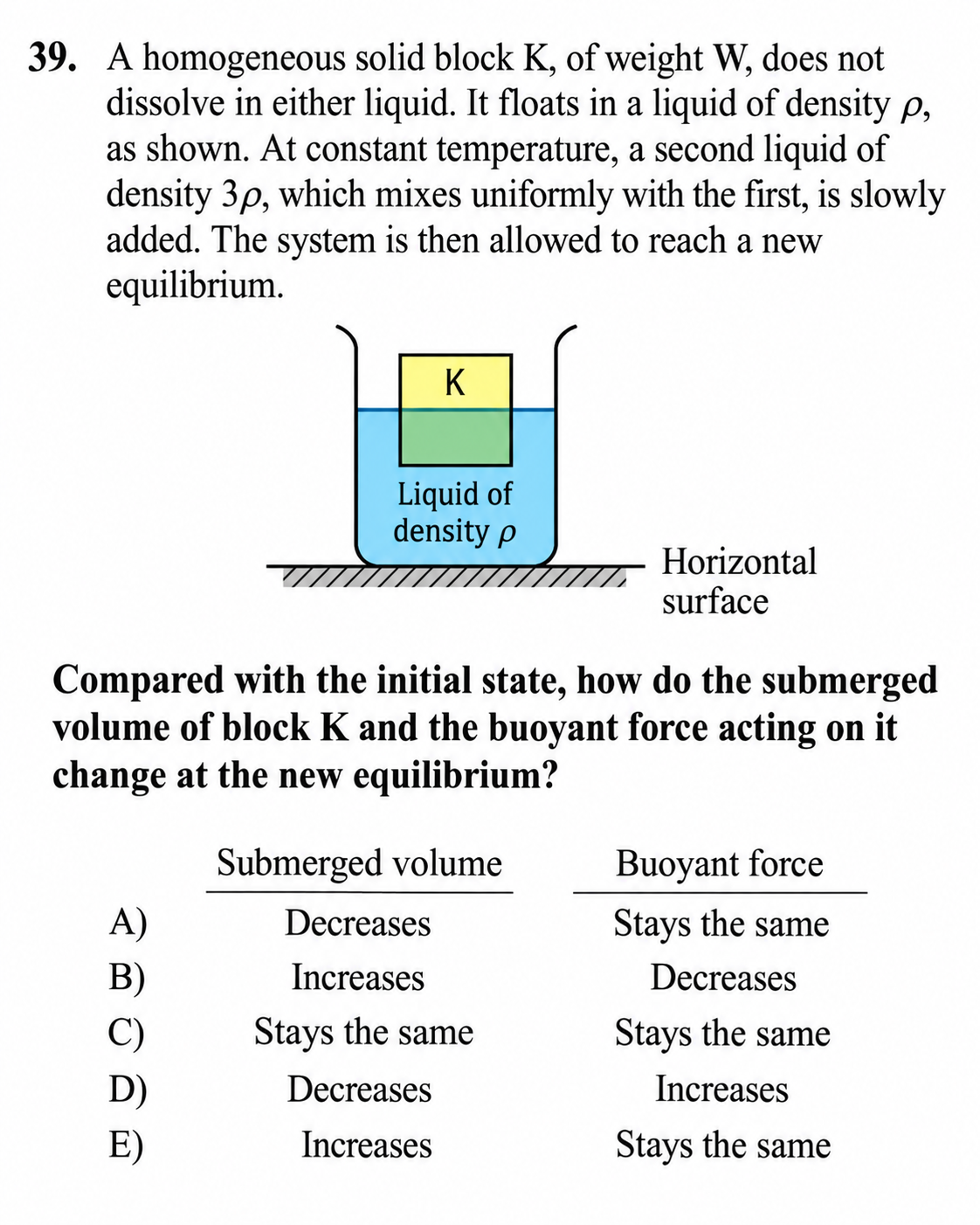
A homogeneous solid block K, of weight W, does not dissolve in either liquid. It floats in a liquid of density ρ, as shown. At constant temperature, a second liquid of density 3ρ, which mixes uniformly with the first, is slowly added. The system is then allowed to reach a new equilibrium.
Compared with the initial state, how do the submerged volume of block K and the buoyant force acting on it change at the new equilibrium?
| Option | Submerged volume | Buoyant force |
|---|---|---|
| A | Decreases | Stays the same |
| B | Increases | Decreases |
| C | Stays the same | Stays the same |
| D | Decreases | Increases |
| E | Increases | Stays the same |
While floating, Fb = W. The weight stays constant.
Adding liquid of density 3ρ makes the mixture denser.
Since V = W / (ρmix g), submerged volume decreases.
See why the block rises while the buoyant force stays the same.
Step-by-step explanations
Raku AI explains the method as well as the calculation. Ask a follow-up question whenever you need a closer look at the reasoning.
Example geometry solution: A circle centred at O has radius 3. A is 5 units from O, and AT is tangent to the circle at T. Since OT is perpendicular to AT, Pythagoras gives 3² + AT² = 5², so AT = 4 units.
Keep learning
Build understanding one question at a time, with explanations you can return to when you need them.
Keep your questions and explanations together. Revisit a solution when you revise a topic.
Ask why a method works or how a particular step follows. Continue the conversation until the reasoning is clearer.
Request a video walkthrough for supported questions, alongside the written solution.
Take a photo in the app, select an image from your gallery, or type your question. Once you have a solution, you can ask follow-up questions about the steps.
Raku AI helps explain school and study questions, including math and science. It is a learning aid, and the quality of an explanation depends on the question and the information you provide.
After receiving a written solution, you can request a video for supported questions. Availability and usage depend on your plan and remaining entitlements, which are shown in the app.
The app offers subscriptions and additional usage packs. Current prices, included features and usage limits are shown before you make a purchase.
AI can make mistakes. Review the reasoning and check uncertain answers with your teacher or a reliable study resource.
Early access
Join the Raku AI waitlist. Tell us what you study, and we will email you when your access is ready.
Joining the list does not give immediate access. Invitations are sent in stages.